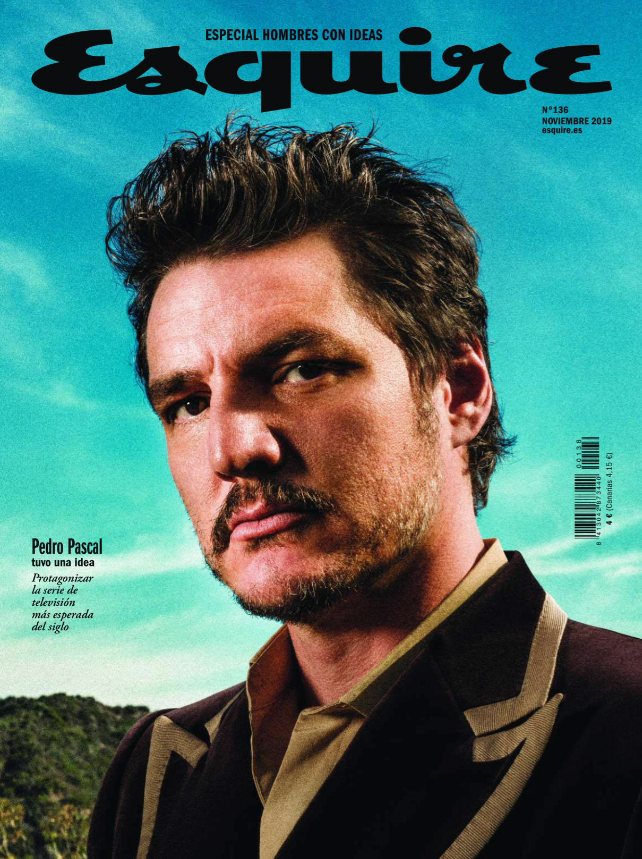
Esquire Spain — November 2019
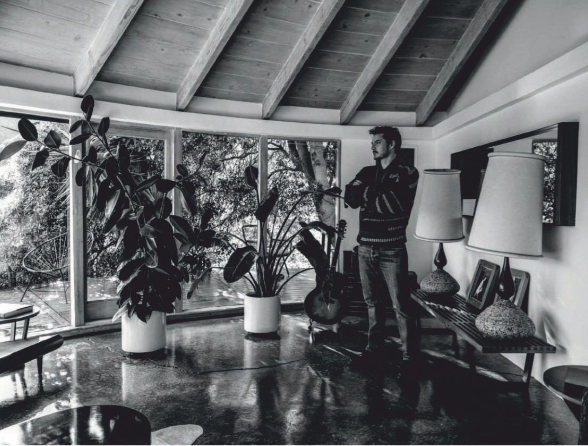
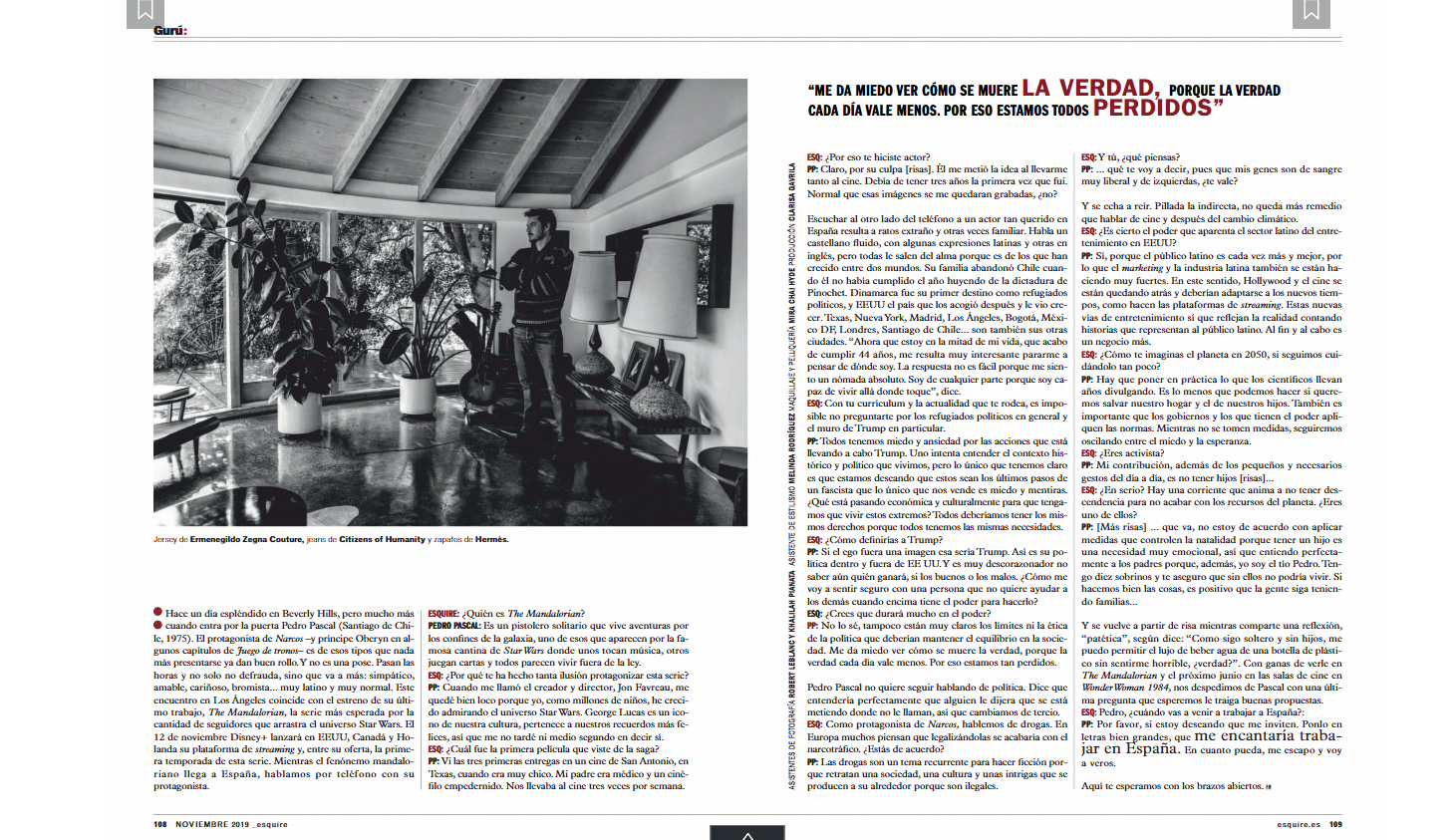
Photo caption: Ermenegildo Zegna Couture sweater, Citizens of Humanity jeans, and Hermès shoes.
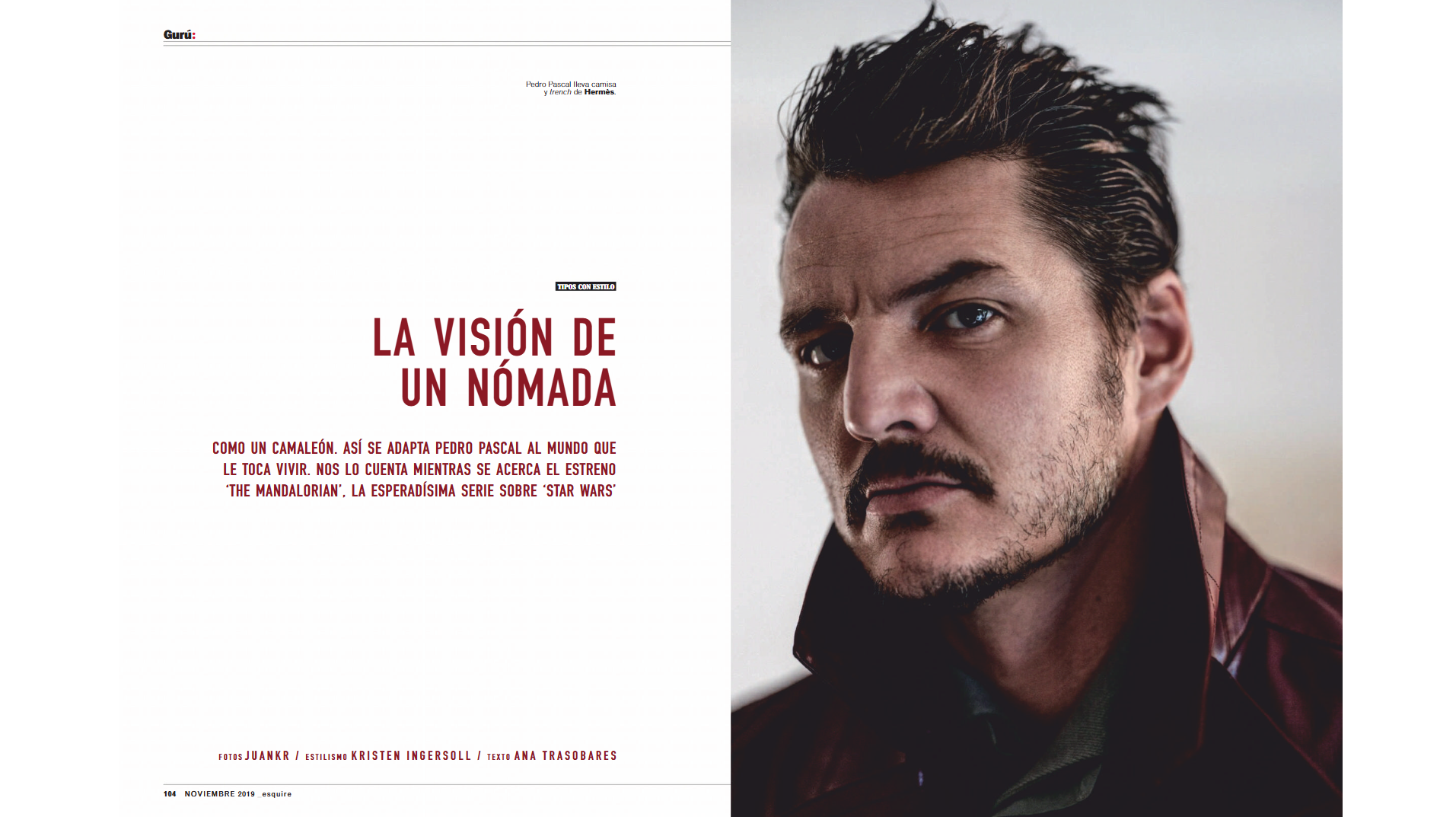
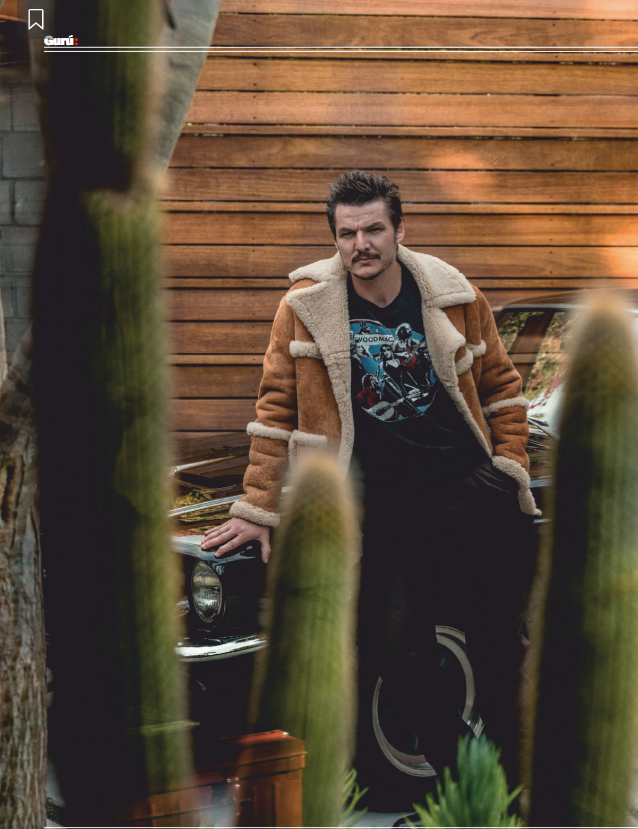
It’s a splendid day in Beverly Hills, but it gets even better when Pedro Pascal (Santiago, Chile, 1975) walks through the door. The star of Narcos and Prince Oberyn in several episodes of Game of Thrones is one of those people who gives off good vibes from the moment you meet him. And it isn’t an act. As the hours go by, not only does he not disappoint, he gets even better: friendly, kind, affectionate, funny… very Latino and very down-to-earth.
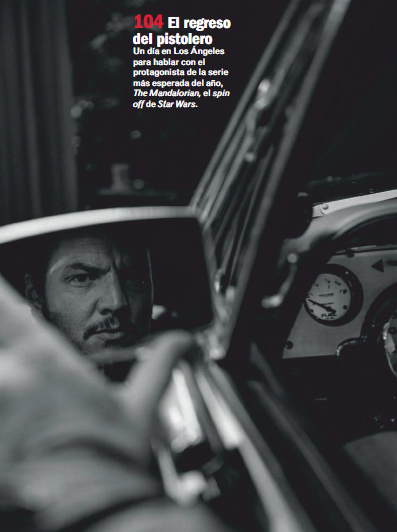
Our meeting in Los Angeles coincides with the premiere of his latest project, The Mandalorian, perhaps the most eagerly anticipated series because of the enormous following surrounding the Star Wars universe. On November 12, Disney+ will launch its streaming platform in the United States, Canada and the Netherlands, with the first season of the series among its offerings. While the Mandalorian phenomenon makes its way to Spain, we speak by phone with its star.
ESQUIRE: Who is The Mandalorian?
PEDRO PASCAL: He’s a lone gunslinger who has adventures on the outer reaches of the galaxy, one of those guys you might see in the famous Star Wars cantina, where some people are playing music, others are playing cards, and everyone seems to live outside the law.
ESQUIRE: Why were you so excited to star in this series?
PEDRO PASCAL: When the creator and director, Jon Favreau, called me, I completely lost my mind because, like millions of kids, I grew up admiring the Star Wars universe. George Lucas is an icon of our culture. He belongs to some of our happiest memories, so it didn’t take me even half a second to say yes.
ESQUIRE: What was the first movie in the saga that you saw?
PEDRO PASCAL: I saw the first three movies in a theater in San Antonio, Texas, when I was very little. My father was a doctor and a die-hard movie lover. He took us to the movies three times a week.
“I’m afraid to see how the truth is dying, because the truth is worth less every day. That’s why we’re all so lost.”
ESQUIRE: Is that why you became an actor?
PEDRO PASCAL: Of course, it’s his fault [laughs]. He planted the idea in me by taking me to the movies so much. I must have been three years old the first time I went. No wonder those images stayed engraved in my memory, right?
Hearing an actor who is so beloved in Spain on the other end of the phone feels strange at times and familiar at others. He speaks fluent Spanish, with some Latin American expressions and others in English, but all of them come naturally because he is someone who grew up between two worlds.
His family left Chile before he had turned one, fleeing the Pinochet dictatorship. Denmark was their first destination as political refugees, and the United States was the country that later welcomed them and watched him grow up. Texas, New York, Madrid, Los Angeles, Bogotá, Mexico City, London, Santiago de Chile… these are also his cities.
“Now that I’m halfway through my life and I’ve just turned 44, I find it very interesting to stop and think about where I’m from. The answer isn’t easy because I feel like an absolute nomad. I’m from anywhere because I’m capable of living wherever I happen to land,” he says.
ESQUIRE: Given your background and everything happening around you today, it’s impossible not to ask you about political refugees in general and Trump’s wall in particular.
PEDRO PASCAL: We all have fear and anxiety about the actions Trump is taking. You try to understand the historical and political context we’re living through, but the one thing we know for certain is that we desperately hope these are the final steps of a fascist whose only thing to sell us is fear and lies. What is happening economically and culturally that we have to live through these extremes? We should all have the same rights because we all have the same needs.
ESQUIRE: How would you define Trump?
PEDRO PASCAL: If ego were an image, it would be Trump. That’s his politics both inside and outside the United States. And it’s very disheartening not knowing yet who will win, the good guys or the bad guys. How am I supposed to feel safe with someone who doesn’t want to help other people when he has the power to do so?
ESQUIRE: Do you think he’ll remain in power for long?
PEDRO PASCAL: I don’t know. The limits and the ethics of politics, which should maintain balance in society, aren’t very clear either. I’m afraid to watch the truth die, because the truth is worth less every day. That’s why we’re so lost.
Pedro Pascal doesn’t want to keep talking about politics. He says he would completely understand if someone told him he was getting involved in something that wasn’t his place, so we change the subject.
ESQUIRE: As the star of Narcos, let’s talk about drugs. In Europe, many people think that legalizing them would put an end to drug trafficking. Do you agree?
PEDRO PASCAL: Drugs are a recurring subject in fiction because they portray a society, a culture and the conflicts that develop around them because they are illegal.
ESQUIRE: And what do you think?
PEDRO PASCAL: …What do you want me to tell you? My genes run very liberal and left-wing. Does that answer your question?
He bursts out laughing. Taking the hint, there’s nothing left to do but talk about movies, and then climate change.
ESQUIRE: Is the Latino entertainment sector in the United States really as powerful as it seems?
PEDRO PASCAL: Yes, because the Latino audience is becoming larger and stronger, so Latino marketing and the Latino industry are becoming very powerful as well. In that sense, Hollywood and the film industry are falling behind and should adapt to the changing times, the way streaming platforms have. These new forms of entertainment really do reflect reality by telling stories that represent Latino audiences. At the end of the day, it’s another business.
ESQUIRE: How do you imagine the planet in 2050 if we continue taking such poor care of it?
PEDRO PASCAL: We need to put into practice what scientists have been telling us for years. It’s the least we can do if we want to save our home and our children’s home. It’s also important for governments and the people who hold power to enforce the rules. As long as action isn’t taken, we’ll continue swinging between fear and hope.
ESQUIRE: Are you an activist?
PEDRO PASCAL: My contribution, besides the small but necessary things we do every day, is not having children [laughs]…
ESQUIRE: Seriously? There’s a movement encouraging people not to have children so we don’t exhaust the planet’s resources. Are you one of them?
PEDRO PASCAL: [More laughter] No way. I don’t agree with imposing measures that control birth rates, because having a child is a deeply emotional need. So I completely understand parents. Besides, I’m Uncle Pedro. I have ten nieces and nephews, and I can assure you I couldn’t live without them. If we do things properly, it’s a positive thing for people to continue having families…
He starts laughing again as he shares what he calls a “pathetic” observation:
“Since I’m still single and don’t have children, I can allow myself the luxury of drinking water from a plastic bottle without feeling horrible, right?”
Eager to see him in The Mandalorian and, the following June, in theaters in Wonder Woman 1984, we say goodbye to Pascal with one final question that we hope will bring him some good offers.
ESQUIRE: Pedro, when are you going to come work in Spain?
PEDRO PASCAL: Please, I’m dying for someone to invite me. Put it in really big letters: I would love to work in Spain. As soon as I can, I’ll get away and come see you.
We’ll be waiting for you with open arms.
Credits: Photography assistants: Robert LeBlanc and Khalilah Piimar. Styling assistant: Melinda Rodríguez. Hair and makeup: Mira Chai Hyde. Production: Clarisa Gavrila.